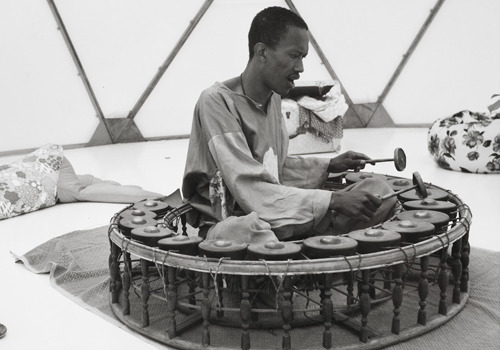
An Organic Music Society: Don, Neneh, Kieran, Terry, and the Thing!
For all the vocal repetition, humming and ah-ing, ‘North Brazilian Ceremonial Hymn’ never suffers from familiarity nor predictability. That despite being perfectly obvious in structure and narrative at no point does it feel stale or worked. It doesn’t leave the listener with the angst not apprehension for change. It expands and contracts with grace. It is a cohesive construction of mood and sound. Cyclical tones heard as one complete arc, one singular narrative. It is remarkable.
It’s impossible that Kieran Hebden is unfamiliar with Organic Music Society. He knows the record and it shows. His understanding of it can be heard in his remix of Neneh Cherry & The Thing ‘Dream Baby Dream’. In its returning, hypnotic nature, it shares the tone of ‘North Brazilian Ceremonial Hymn’. It retains the slow reveal, the patient inquisition into music.
The original by Suicide has a distinct structure: a mangled Casio baseline bastardised, vomited through peaking equalisers, and delivered with the razor toothed regularity of a Motorik drummer. Coughing up similar results when transposed to different musicians. The Thing create a mountainous crescendo. The relentless aural pounding of the original rejected in favour of a shapely climb. The Thing move the track away from the original, before Hebden reels it back in.
Much less is his mindset of post punk framing, void of friction or angst, the Four Tet remix is fluid and restrained. A xylophone and Neneh’s vocal: “dream baby dream” and “keep those dreams burning forever" perform a dance over the techno bed. The relationships between these interpretations swirl around. This isn’t an arbitrary case of a composition performed and edited in contrasting ways. This is a community drunk with ideas, communicating those through their craft, and producing intoxicating music in the process.
Whilst the original vocal is both comedic and adulterated, Neneh Cherry performs the song as a mother. A role augmented as the xylophone remembers a lullaby on baby mobile. She is a guiding voice giving the song a purpose that would otherwise be lost in the musicological mist.
2012 heard a lot of talk concerning inheritance and our social responsibility – what our society should look like from a moral perspective. The political fall out of the Arab spring and Egypt’s new government. The legacy a Summer of games and the socially tender streets of East London. The bind of lending and a divided senate on a new Presidential term. Stoicism in political handover in China. The environment. How much tax corporations should pay. How much support should nations and individuals receive. We want to adopt a greater sense of responsibility and morality. For me, there’s a growing sense of ethical responsibility working its way into everything we do, more than the detergents we buy to the outlets we shop in, rather fundamental questions our our government. The society our actions shape, and the world our society leaves behind.
One question that continued throughout the year was the legacy of Barack Obama. Had he departed office last November what would his legacy have been? A captain who tried to steer a mutinous ship, or a ruthless general aggressively bombing Pakistan with drone strikes. Now he has another chance to shape his legacy.
What has been fascinating to imagine, between Organic Music Society and Dream Baby Dream is the relationship. What has been shared, what has been inherited, what has been improved on, what has evolved. When Don Cherry recorded the LP he involved all sorts of musicians. There are school children on camp in America, there are session musicians in Stockholm and New York, there’s Terry Riley whose influence can only be heard on a manuscript rustling inaudibly on Terry’s Song. There’s so much communication and exchange of ideas. There’s so much democracy at work. There are so many thoughts adopted.
The Four Tet remix of a Suicide song covered by a collaboration between ensemble The Thing and a singer creates its own organic music society. We are invited to listen to the musicians communicate to each other through the artefact of a recording. In a couple of records we can see more communication, more compromise, a greater tolerance of ideas, and more intelligence, than that which is frequently on show between governments and citizens. In these records I’ve harboured a serenity. A utopia that I would struggle to have found looking outward in 2012.
 Home
Home 
Leave a Reply