In the summer of 1908, the Schönbergs’ marriage collapsed. Arnold’s wife, Mathilde, had entered into an affair with the painter Richard Gerstl, who was twenty-five, intense, and prone to violence.
Gerstl had become known to the Schönbergs the previous year. Introduced while Arnold was teaching counterpoint and theory to a small circle of devoted students. Schönberg admired the painter’s candour; Gerstl, though privately dismissive of the composer’s modernist ambitions, found himself drawn into questions of form, expression, and freedom.
Both were intent on fracturing form, each seeking the unvarnished core of feeling. In his portraits Gerstl dissolved the figure into swirls of colour and broken texture, faces glaring back with unnerving hostility. Schönberg, in turn, was pushing harmony beyond resolution, allowing intervals to wander untethered from a tonal center.
That summer, Gerstl’s paintings were rejected from the Akademie’s exhibition. Enraged, he directed a furious letter at the institution and its professors, a broadside that only widened his estrangement. By October he would be expelled outright.
The rejection seemed to tip him into volatility. His canvases grew jagged, their brushwork slashed and finger-smeared. Two extraordinary works emerged from this period: one showing Schönberg with his family, another a group portrait of Schönberg and friends. Faces and bodies are raw, gouged into being, as though the brush revealed anxieties beneath the skin. Backgrounds dissolve into turbulence. You can feel the push and pull of thoughts in Gerstl’s mind, the love he was creating, the family he was dismantling.
Yet the canvases radiate a strange vitality: sunlight flickering through the chaos, a brightness at odds with their menace. They bore witness to emotions that Vienna’s polite salons could not contain.
The affair would falter. Pressured by family and convention, Mathilde pleaded to return to her husband and children. Leaving Gerstl withdrawn in the darkness of his atelier.
Despite claims that the affair had ended, returning home, Schönberg finds them coupled in sweat.
A burst of notes are sent from Mathilde to Arnold, 27-28 August: overwritten in crayon, desperate, suicidal,
“I have only one hope, that I will not live much longer It passes quickly now dear and I am glad of that. Now there is really no one I have to live for. I think you would then also forgive me. Now, coming to the end, I have still a request. A few lines, don’t think that I hope that you want me back, only I would so much like to know how you and the children are.”
On November 4, having not received an invitation to one of Schoenberg’s premieres, Gerstl locked himself in the hotel room, hanged himself, and then, perhaps to make certain, stabbed himself in the chest. His brother, hearing the commotion, broke down the door to see the body still swinging.
In her correspondence with Gerstl’s family, Mathilde seemed to cast his death as a kind of release,
“I am so poorly and down because of the tragedy, that I found it to be impossible. I certainly hope to speak to you, when we are all somewhat calmer. I would only now ask you, if you should find something in Richard’s studio, that you suspect to belong to me, simply to destroy it. Please do not send me anything, it is all so terribly painful, and only reminds me of the tragic misfortune. Believe me, Richard has chosen the easiest way for both of us. To have to live, in such circumstances, is very hard.”
In Viennese circles, death was neither distant nor abstract. It hovered in the air of cafés and concert halls, in the newspapers and the whispered gossip of salons. Young artists and intellectuals were acutely aware that life and mortality were not separated by a clear boundary. Suicide, illness, sudden disappearance; they were as much a part of the city’s rhythm as trams clattering down the Ringstraße. Ludwig Wittgenstein, reflecting on the frequency of such deaths, observed that if suicide is allowed, then so is everything.
The city, a deathly opera, pulsed with dangerous freedoms: Otto Weininger, the controversial philosopher and sexologist, ended his life in the same house where Beethoven had once died, a gesture heavy with historical resonance (I can’t believe Beethoven was took well to irony). The Austrian poet Georg Trakl, whose lines traced despair and isolation, died in a hospital from an apparent cocaine overdose. Max Steiner poisoned himself. The double suicide of Crown Prince Rudolf and his lover Mary Vetsera at Mayerling was a gossip, a mixture of personal anguish and social fascination, grim symbols of an era in which intellectual intensity could not be pulled from the hiss and snap of the fire.
The fascination was not merely morbid. It was existential. Artists were attuned to the fact that life was never a guaranteed continuum; it could be interrupted, fractured, made to fold back upon itself. In the universities, orchestras, and in the printed page, one could see the same preoccupation manifest: the dismantling of form, the dissolution of familiar structures, the audacity to confront the void directly. Suicide and illnesswere not only personal tragedies but also acts that illuminated the tenuousness of being, gestures that forced both creator and witness to reckon with mortality as a constant companion.
For Schoenberg, the consequences were less immediate but no less profound. His marriage continued, yet its foundation had been shaken, and the sense of betrayal and collapse became inseparable from his interior life. Into his music and his next phase of artistic development he carried a new awareness of fragility and the violence of emotion.
In the shadow of wedlock, and Gerstl’s death, Schoenberg started to compose Das Buch der Hängenden Garten. The work occupies a precarious space between leider and confession. The poems are both intimate and disorienting, a landscape of desire and estrangement suspended in time. The title itself. “The Book of the Hanging Gardens” suggests a place of cultivation, yet one under tension, as if the beauty it contains were always at risk of collapse. Gardens hang; they are not grounded, and neither is the music. The phrase recalls the Hanging Gardens of Babylon, their grandeur, artifice, and ultimately ruin.
The poems dwell on love, longing, and loss, but they do so in fragments. The language is precise, formal, almost ritualistic, yet it is shot through with tremors: unspoken love, the impermanence of beauty, the inevitability of absence. Schoenberg translates these tremors into sound. Lines end not with closure but with hesitation. Harmonies do not resolve; intervals hover, waiting, uncertain. There is no comfort of predictability, no promise that the voice will meet its echo. Each song is a miniature world of yearning, a suspended moment in which the listener is both observer and participant in the emotional turbulence.
Tonal centres and cadences no longer contained the emotional truth he sought; love, loss, and estrangement demanded a different approach. In this rupture, he encounters the void of atonality. Notes float freely, sometimes colliding, sometimes echoing, unbound by expectation. The familiar narrative arc of rise, tension, resolution was abandoned.
The listener is drawn close, yet never allowed the reassurance of tonal resolution. Desire is articulated but never satisfied; beauty is offered but immediately destabilised. Decay is present not only in the thematic content but in the very structure of the music: motifs collapse before they cohere, phrases fracture and drift apart. Schoenberg’s voice becomes a mirror for the anxieties and obsessions of a life shaped by betrayal and loss, yet it also achieves a universality: the music and the poetry together make audible the fragility of human experience.
In this way, Das Buch der hängenden Gärten is not simply an early experiment in atonality, it’s a meditation on impermanence, a record of emotional truth in a time of private calamity. The listener is invited into a garden that can never be fully possessed, a soundscape in which every resolution is deferred, every longing made palpable, every absence felt.
I was thinking about Schönberg and Das Buch der hängenden Gärten when visiting the Anselm Kiefer exhibition at White Cube, Mason’s Yard, London. The idea of a world suspended in both life and death, where emotions and music don’t resolve.
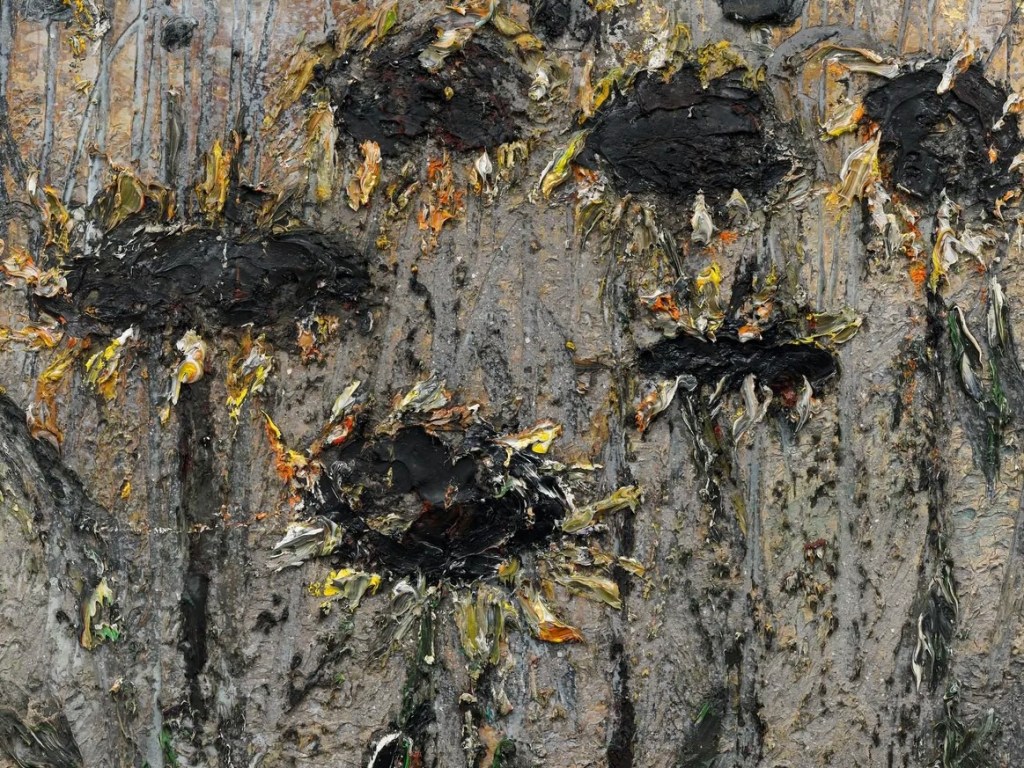
Kiefer’s canvases are haunted by time: sunflowers suspended in bloom and decay, flourishing and withering, stretched crusted and cracked across the polarities of existence. In them, the contradictions of living, the pull of passion against the inevitability of loss are palpable, rendered in thick, darkened layers of paint and gold, in the residue of earth and ash.
I’ve not encountered many works that express the internalised tension that persists while living, the sense that death is threaded through us.
It would be easy, superficially, to compare Heidegger’s postwar meditations on being-toward-death and Kiefer’s reflections on the devastation of war. But Kiefer’s new work offers something more subtle, more insistent: death hangs in us, in the gestures we repeat, the anxieties we ignore, the silences we permit.
Schönberg bottles this tension in sound, creating a landscape in which desire, loss, and alienation are audible. Each note exists in precarious relation to the next, as though time itself were unmoored, and the listener is made aware of every lapse, every hesitation, every fragment of longing.
A voice that wanders like a shadow
Across the terrain of the self;
Sometimes intimate, sometimes otherly.
 Home
Home 